

The manufacturing process for stainless steel braided hoses involves extruding an inner core, braiding stainless steel wire around it, and attaching end fittings. The production of each braided hose assembly consists of four stages: core formation, braiding, fitting assembly, and testing. Established suppliers follow these standard procedures to ensure that every hose assembly meets consistent quality standards.
Key Takeaways
- The manufacturer begins by producing the inner core. Designed to transport fluids, this core must meet specific operational requirements.
- The inner core is encased in a braided layer of stainless steel wire, which provides added strength and prevents the hose from kinking.
- Fittings are attached via crimping, and every hose undergoes pressure and leak testing. These processes ensure the safety and reliability of the product.
Forming the Core of Steel Braided Hoses
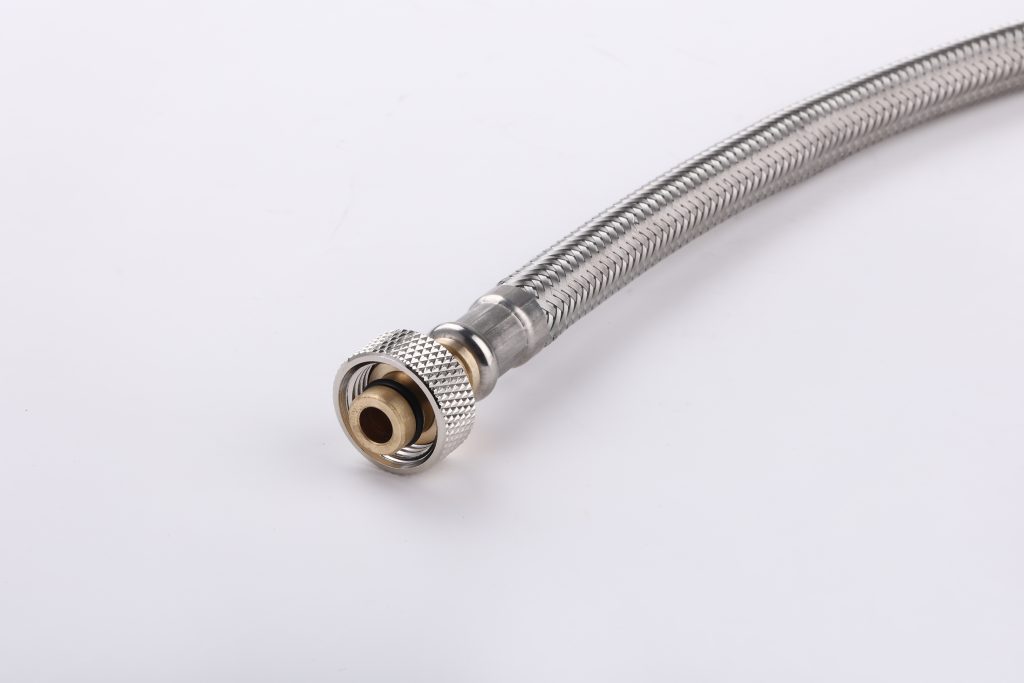
The inner core is the central component of any braided hose assembly. Because it comes into direct contact with the fluid being transported, the material chosen for the core must meet the specific requirements of the operating conditions. For hot and cold water piping, such as in a flexible shower hose, manufacturers typically use EPDM (ethylene propylene diene monomer) rubber or PEX (cross-linked polyethylene). In applications requiring high purity or resistance to chemical corrosion, a PTFE (polytetrafluoroethylene) liner is often selected. Furthermore, some hose designs utilize a flexible metal core, while others employ PTFE as a base layer. GONGGONG offers braided hoses featuring these various types of inner cores, providing the most suitable solutions for a wide range of application scenarios.
Extruding the Inner Tube
The extrusion process shapes a mixture of raw materials into continuous tubing. This process consists of three main steps:
- Heating and Melting—The rubber compound is heated until it reaches a molten state, becoming sufficiently pliable to flow through an extrusion die.
- Extrusion—The molten rubber is forced through a specifically shaped die to form a continuous inner tube with the desired diameter and wall thickness. This step allows for the control of wall thickness and surface smoothness, which in turn influences the tube’s pressure resistance and wear resistance.
- Cooling and Setting—The extruded tubing passes through a water bath or an air-cooling system, which causes it to harden and retain its shape.
Tubing produced via the extrusion process features precise, uniform dimensions and a smooth, consistent inner bore. This internal structure facilitates smooth fluid flow and helps minimize turbulence. The manufacturing method for metal tubing differs: stainless steel strips are roll-formed and welded to create a corrugated structure, which imparts flexibility to the tubing. Before the corrugation process, the steel strip is first welded to form a closed, tubular structure.
Curing and Sizing the Core
The curing process stabilizes extruded tubing. Through heat treatment or the application of chemical agents, cross-linking reactions occur within the material, granting the tube core its final strength and elasticity. Subsequently, a sizing process adjusts the tubing to the precise diameter and length required by the client. Manufacturers and suppliers can provide customized lengths and diameters, ensuring that the braided hose fits specific installation spaces without being subject to stretching or kinking. GONGGONG offers both wholesale and customized products through OEM and ODM partnership models. Before proceeding to the braiding stage, every tube core must undergo raw material inspection.
Braiding the Flexible Metal Hose
Preparing the Wire
The braiding process begins with the preparation of the metal wire. Stainless steel wire is wound onto spools and fed into a braiding machine. The grade of the metal wire is critical: SUS304 stainless steel is typically used for the braided layer, while the inner hose may be constructed from SUS304, 321, or 316L stainless steel. Flexible metal hoses manufactured in this manner maintain excellent flexibility while offering superior resistance to bursting, cracking, and crushing.
Prior to braiding, the surface of the metal wire may undergo pre-treatment. For instance, a layer of TPU (thermoplastic polyurethane) can be applied to the wire via a dip-coating process. Spectroscopic analysis is used to verify that the coating has firmly adhered to the wire surface. These coated wires are then combined with uncoated wires and fed into the braiding machine.
The settings of the braiding machine determine the quality of the braid pattern. Operators must load the wires into the machine’s carriers and ensure that the tension of each wire remains consistent. Uneven tension can result in an irregular braid pattern and create weak points within the braided layer.
| Specification | Value |
|---|---|
| Braid Material | SUS304 |
| Hose Material | SUS304, 321, 316L |
| Size Range | DN8–400 mm |
| Wall Thickness | 0.15–0.6 mm |
| Pitch Distance | 3–50 mm |
The Braid Process
A braiding machine wraps metal wire around an inner tube (core) at a specific angle and coverage rate. The “braid angle”—the acute angle formed between the wire and the hose axis—is typically maintained by manufacturers between 45 and 55 degrees, a range that strikes an optimal balance between hose flexibility and pressure resistance. “Coverage” refers to the percentage of the surface area shielded by the braided layer; higher coverage enhances the hose’s resistance to abrasion and kinking, while also improving its ability to withstand pressure loads.
Metal hoses can feature either a single-layer or double-layer braid. Single-layer stainless steel braids are suitable for standard operating conditions, whereas double-layer braids can endure significantly higher pressures. For ultra-high-pressure applications, a combination of a double-layer braid and a 316L stainless steel inner tube is often employed to provide both high pressure resistance and corrosion resistance. In cases where a full stainless steel exterior is not required, polymer or nylon braids offer a flexible and cost-effective alternative.
Metal hoses can feature either a single-layer or double-layer braid. Single-layer stainless steel braids are suitable for standard operating conditions, whereas double-layer braids can endure significantly higher pressures. For ultra-high-pressure applications, a combination of a double-layer braid and a 316L stainless steel inner tube is often employed. In cases where a full stainless steel exterior is not required, polymer or nylon braided hoses offer a flexible and cost-effective alternative.
Attaching Fittings to Braided Hoses

Crimping End Fittings
Workers fit brass end fittings over the braided layer and inner core of the hose. A ferrule is positioned between the fitting and the braided layer to help distribute the load. A crimping machine then compresses the ferrule uniformly around the fitting, creating a leak-proof seal capable of withstanding high pressure.
The entire process follows a set sequence of steps. Technicians trim the end of the hose to ensure a flat surface, remove any burrs, and flush out the internal bore. They select the appropriate die set based on the hose specifications and the type of fitting, then push the fitting fully into place. The crimping machine compresses the ferrule to a specified diameter, and the final assembly is checked with calipers to ensure it meets tolerance requirements. This crimping method is well-suited for the large-scale production of wire-braided hoses, ensuring consistency across every unit.
Pressure and Leak Testing
Testing confirms that every assembly offers reliable performance. Static pressure testing involves applying a pressure equivalent to 1.5 times the operating pressure and maintaining it for two minutes. Burst testing entails continuously increasing the pressure until the hose fails; the burst pressure must be at least four times the operating pressure. Leak testing is conducted by pressurizing the hose with air or nitrogen and submerging it in water; the appearance of air bubbles indicates a defect.
| Test | Procedure | Criterion |
|---|---|---|
| Static pressure | 1.5× working pressure, hold 2 minutes | No leakage |
| Burst | Pressurize at 0.34–1.0 MPa/s | Burst ≥ 4× working pressure |
| Leak | Immerse pressurized hose in water | No bubbles |
GONGGONG conducts rigorous inspections of raw materials, ensuring that its products meet a wide range of standards and certifications, including WRAS, ACS, KTW/W270, WaterMark, ISO 9001, and CE. The company provides OEM and ODM services to major global brands. Its braided hoses are widely used in various applications, such as faucets, high-end shower systems, bidets, kitchen water supply lines, and HVAC (heating, ventilation, and air conditioning) systems. Clients have the option of bulk purchasing or requesting customized products.
The manufacturing process involves producing an inner tube, wrapping it with an outer layer of stainless steel wire, attaching fittings via crimping, and finally performing comprehensive testing. Each stage is critical to the overall strength of the braided hose. A high-quality supplier ensures consistent product standards across both bulk and custom orders. GONGGONG adheres strictly to this production process for every braided hose assembly; please feel free to contact the manufacturer directly to discuss your next order.
FAQ
What does the stainless steel braid do on a braided hose?
The braid carries pressure and guards the core against abrasion and kinks. It also keeps the hose from stretching. A double braid raises the pressure rating of the assembly.
Why do some hoses use a corrugated metal core?
A corrugated core bends without collapsing. Manufacturers roll and weld a stainless strip, then shape the corrugations. The braid covers this core and holds the assembly steady under pressure.
How do fittings stay leak-proof on steel braided hoses?
Workers crimp a brass fitting over the braid and core with a braid collar between them. A pressure test at 1.5 times working pressure confirms each assembly holds.