

To determine which shower hose you need, consider three key factors: connector size, hose length, and material. These details determine whether the new hose will fit your setup, provide sufficient reach, and offer long-lasting durability. A mismatch in any of these areas could lead to leaks, kinking, or unnecessary waste.
Start by verifying the connector size—measure the thread specifications of both the shower outlet and the handheld showerhead. Next, check the length by measuring the distance from the outlet to the handheld showerhead while the hose is naturally extended. Finally, select a suitable material based on water temperature and your cleaning habits. This guide walks you through each step to help you confirm product compatibility before placing your order.
Key Takeaways
- First, check the connection size. Measure the threads on the shower outlet and the handheld showerhead; the common specification is G1/2 BSPP, with a diameter of approximately 0.84 inches.
- Measure the distance from the outlet to the handheld showerhead and allow for at least 8 inches of extra slack for movement. A 60-inch hose is suitable for most bathrooms.
- Opt for durable materials, such as stainless steel braided hoses, which are rust-resistant, kink-resistant, and heat-resistant. It is recommended to choose products with certifications such as WRAS or WaterMark.
- Select features that enhance your shower experience. An anti-tangle design prevents the hose from knotting, while an easy-to-clean surface prevents soap scum buildup.
- Be sure to measure and verify compatibility before purchasing to avoid issues like leaks, kinks, or the need for returns, ensuring you select a hose that is the right size, appropriate length, and durable.
Check the connection size of the shower hose
The first thing to check is the connection size. A shower hose connects two points: the wall outlet and the handheld showerhead. Both ends of the hose must match the threads on these fixtures. Mismatched sizes are the most common reason why a newly purchased shower hose cannot be installed, so buyers should take measurements before placing an order.
Measure Your Threads
Remove the showerhead from the shower arm. Use a ruler or a pair of calipers to measure the outer diameter of the shower arm threads. For standard 1/2-inch NPT threads, the diameter is approximately 0.84 inches (21.3 mm). If the measured diameter falls roughly between 0.8 and 0.85 inches, it meets this standard. Extreme precision is not required at this stage; the goal is simply to confirm that the diameter is closer to 0.84 inches than to 0.75 inches.
A thread gauge can be used to check the thread pitch and size. These tools are inexpensive and available at most hardware stores. Check near the base of the shower arm for stamped markings such as “1/2-inch NPT” or “BSP.” If there are no markings, you can remove the shower arm and take it to a hardware store for identification. Alternatively, you can perform a simple test: try screwing on a showerhead of a known specification; if it fits snugly without wobbling or cross-threading, the thread specifications match.
Common Sizes (G1/2)
G1/2 is the most common thread standard for shower hoses in Europe, the UK, Asia, and Australia. To avoid confusion, the full thread specification should be labeled as “G1/2 BSPP” rather than simply “1/2 inch.” G1/2 is a type of BSP parallel thread (BSPP) that relies on a washer or O-ring for sealing, rather than an interference fit between the threads; this distinguishes its dimensional specifications from those of NPT threads.
Please verify that the thread standard aligns with the target market. Hoses manufactured to the G1/2 BSPP standard are suitable for fittings used in regions that follow the BSP standard. For initial production runs or when dealing with new suppliers, require the manufacturer to verify thread dimensions using physical thread gauges rather than relying solely on specification sheets. Thread pitch gauges and calipers can be used to check the number of threads and the outer diameter against published standards (such as ISO 228-1 for BSPP).
Mismatched connection dimensions remain the primary reason why shower hoses cannot be installed. Before purchasing, be sure to measure the dimensions at both ends, confirm the thread standard, and verify compatibility.
Measure The Right Shower Hose Length
Once the connection size is determined, the next step is to check the length. A hose that is too short restricts movement and puts strain on the fittings, while one that is too long can form loops where water pools. The right length allows for freedom of movement without the inconvenience of excess hose. Be sure to measure carefully before purchasing.
Measure From Outlet To Handset
Measure from the shower outlet on the wall to the handheld showerhead holder. Do not measure an old hose that has stretched or become misshapen. Use a tape measure to determine the straight-line distance between these two points, then add at least 20 cm (approximately 8 inches) to allow for freedom of movement while showering. This extra length ensures the user can reach all parts of the body without pulling the hose taut.
Many households use hoses that are 60 inches (5 feet) long. The ShowerHead Store, a well-known retailer of shower products, notes that this is a standard length for shower hoses. When shopping, consumers should verify whether the actual required distance—accounting for necessary slack—aligns with or approximates these standard lengths. A 60-inch hose is suitable if the distance from the water outlet to the holder is 40 inches; however, a longer hose might be preferable if the distance is 55 inches.
The appropriate length depends on the bathroom layout. If the fixed water outlet is positioned above the bathtub, a longer hose is required to reach a seated user; if a slide rail with an adjustable holder is installed, the necessary length depends on the holder’s highest and lowest positions—if the holder is movable, measure its full range of motion.
Tips For Height And Reach
The user’s height is an important factor when selecting the most suitable shower hose length. Taller individuals require a longer hose to easily direct the spray downwards, whereas shorter individuals need a shorter hose to avoid having excess length dragging on the floor.
| User Height Category | Recommended Shower Hose Length |
| Taller than average | A 24-inch hose provides extra reach and clearance for comfortable showering |
| General (any height) | Choose a hose 10–30 cm longer than your own height for optimal comfort |
The table above is based on industry guidelines. Taller users can benefit from the additional extension length. For the average user, adding 10 to 30 cm to their own height serves as a reliable reference for determining the optimal length.
According to ADA standards, if a handheld showerhead is installed at a height of 48 inches or less, the hose must be at least 59 inches long. This requirement is intended to ensure that seated users can comfortably reach the showerhead.
ADA (Americans with Disabilities Act) regulations apply to accessible restrooms. Even if there is no specific need for accessibility features in the home, adhering to these guidelines helps avoid issues with insufficient hose length.
Allow for some extra length; the shower hose should not be under tension during use. Leaving a few inches of slack prevents excessive stress on the brass nuts and the internal rubber tubing. A hose that hangs naturally lasts longer and is less prone to kinking. Additionally, having this extra length makes cleaning easier.
Choosing the right shower hose length depends primarily on three factors: the straight-line distance between the water outlet and the holder, the user’s height, and the slack needed for movement. A 60-inch hose is suitable for most standard home setups; however, if the installation environment is non-standard, you can order a custom length from the manufacturer. Be sure to measure before you buy.
Pick The Best Shower Hose Material
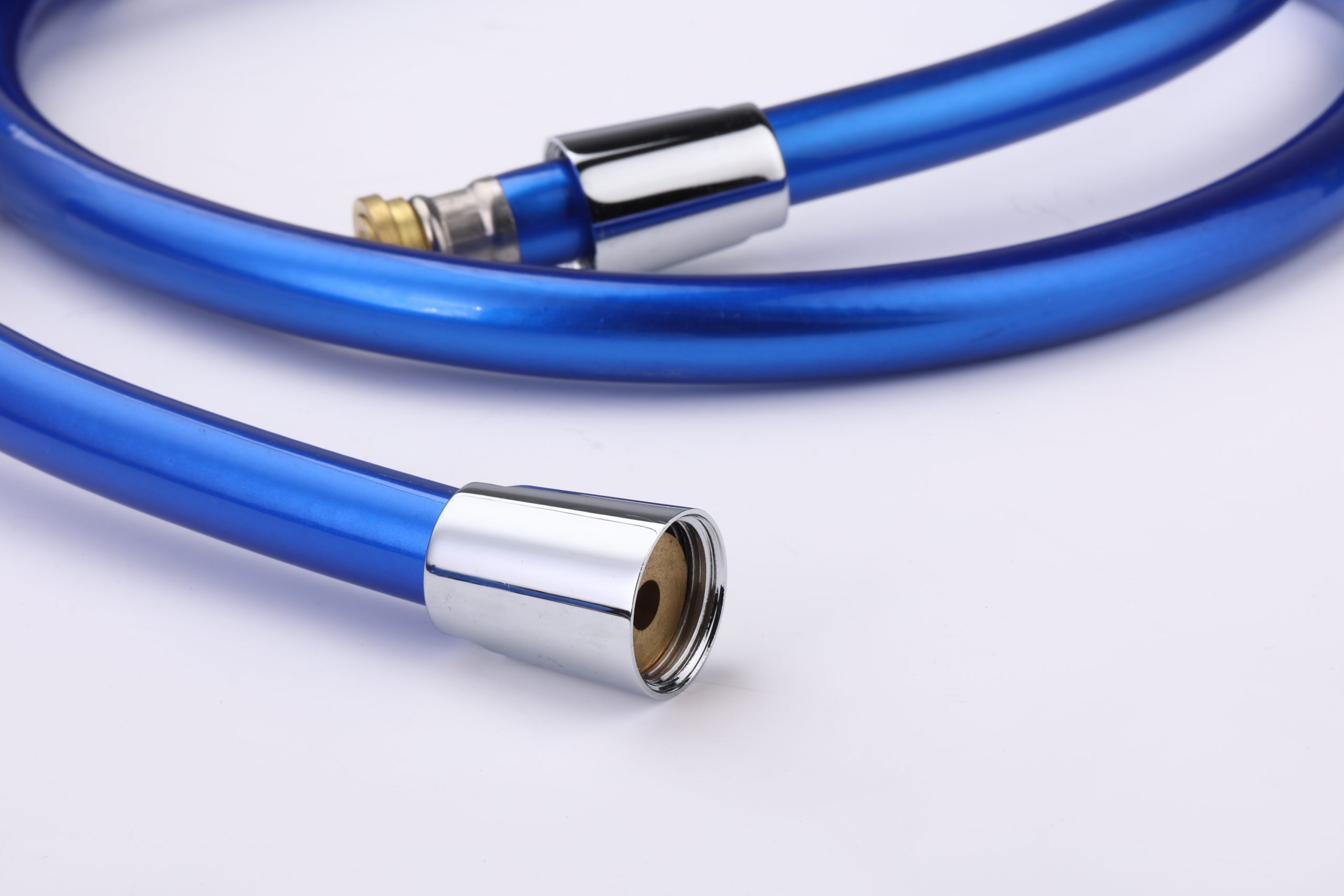
While connection dimensions and hose length are certainly important, the material is the key factor determining whether a shower hose can withstand years of use. To select the ideal shower hose, you need to consider how different materials perform in terms of heat resistance, water pressure tolerance, and resilience against daily bending and stretching. The choice of material directly affects the hose’s lifespan, flexibility, and ease of cleaning.
Different Kinds Of Shower Hoses
Understanding the different types of shower hoses helps you select the right product based on your specific installation needs. PVC hoses are affordable and lightweight, but standard PVC material tends to become brittle over time when exposed to hot water. Stainless steel hoses, on the other hand, are rust-resistant, withstand high water pressure, and are less prone to kinking.
Double-interlock metal hoses feature a structure of two interwoven layers of stainless steel to enhance strength. While standard metal shower hoses typically have a lifespan of about 18 months to two years, the double-interlock design significantly extends this service life. Braided hoses consist of an inner core and an outer protective braided layer.
How Long It Lasts And How Flexible It Is
The service life of a hose depends on its outer material and inner core structure. Compared to standard PVC hoses, braided hoses withstand water pressure better and are more compatible with thermostatic shower systems. The double-layer stainless steel braided structure prevents bursting and minimizes kinking; its flexible design allows for easy movement without placing stress on the connections.
Relevant certifications attest to the safety and production quality of the materials. For instance, certifications such as WRAS (UK), ACS (France), and WaterMark (Australia and New Zealand) all confirm the material’s safety and manufacturing quality. The smooth outer surface of the hose is not only easy to clean but also prevents the buildup of soap scum.
When selecting the ideal shower hose, it is helpful to compare material properties and certification marks. A stainless steel braided hose with the appropriate certifications offers the perfect balance of durability, flexibility, and safety.
Find a Shower Hose That Matches Your Needs
If your shower hose is constantly “fighting against you,” every shower becomes a source of frustration. A hose designed to be tangle-free and easy to clean effectively solves the common issues of tangling and grime buildup—details that are just as important as size and material.
Anti-Twist And Easy-Clean
This anti-tangle shower hose features swivel connectors at both ends. Its outer casing rotates independently of the inner water-carrying tube, utilizing micro ball bearings or a swivel assembly to enable full 360-degree rotation. This design prevents the hose from kinking during movement. An anti-kink hose not only ensures steady water flow but also reduces stress at the connection points.
Key anti-twist features include:
- A patented anti-twist mechanism that allows full rotation without breaking
- Compression-resistant technology that keeps its shape when bent hard
- Reinforced polymer cores with outer layers that resist rust
- An inside design that stops kinks, bends, and loops
Easy-to-clean surfaces prevent the buildup of soap scum and stains. Material selection directly impacts hygiene: unlike plastic, stainless steel is less prone to accumulating grime that harbors bacteria. Plastic materials are more susceptible to cracking and leaking, creating damp areas where mold can thrive. The combination of a high-quality 304 stainless steel body, brass fittings, and a non-toxic silicone inner tube ensures both superior hygiene and exceptional durability.
Universal Fit And Finishes
This universal shower hose is compatible with most standard and adjustable showerheads, handheld showers, and wall outlets. Its universal connectors and flexible design ensure smooth water flow while effectively preventing leaks and kinking. Compatibility depends on whether the connector specifications match the threading of the showerhead and wall outlet.
A variety of finishes are available to complement diverse bathroom décor styles. Each finish undergoes electroplating and clear-coating processes to ensure rust resistance. The main body is constructed from 304 stainless steel, which offers inherent, superior rust resistance; in contrast, conventional hoses—typically made from PVC or 201 stainless steel with a chrome-look finish—are less durable and more prone to rusting.
An ideal shower hose combines anti-tangle functionality, easy-to-clean materials, and a finish that complements your bathroom’s style. These features ensure a comfortable shower experience for the long term.
Choosing the right shower hose requires just three simple checks. First, verify that the connection sizes match the threads on both the water outlet and the handheld showerhead. Second, measure the distance from the outlet to the showerhead while the hose is naturally extended. Third, select a material capable of withstanding high temperatures, high pressure, and frequent daily use. Measuring your current setup and confirming compatibility before placing an order helps avoid issues such as leaks, kinking, or the need for returns. By keeping these three points in mind, anyone can select a hose that is the right size, the proper length, and built to last. Choosing the right product is actually quite simple.
FAQ
How does someone verify the shower hose connection size?
The user measures the threads of the shower arm using calipers. The diameter of the G1/2 BSPP thread is approximately 0.84 inches (21.3 mm). A showerhead of known specifications is installed on the shower arm for testing to confirm compatibility and ensure a secure, wobble-free connection.
What shower hose length works for most home bathrooms?
A 60-inch shower hose is suitable for most standard setups. Users should measure the distance from the wall outlet to the handheld shower holder and add at least 20 cm (8 inches) to ensure freedom of movement.
What maintenance tips extend your shower hose’s life?
Do not pull the hose too tightly during use; maintaining a degree of slack prevents stress on the connections. Wiping down the exterior after each shower helps minimize soap residue buildup, while periodic checks for leaks can extend the product’s service life.
Do certifications matter when choosing a shower hose material?
Yes. Certifications such as WRAS (UK) and WaterMark (Australia) confirm the safety of the materials.