


Most home bathrooms use a standard 1/2-inch thread size to ensure a proper shower hose fit. Finding the right hose depends on three steps: first, check the thread size at the wall outlet and at the handset; second, choose a length that fits your shower layout and how you use it; third, verify that the connector materials, seals and inner liner can handle your water pressure and temperature over the long term.
Key Takeaways
- Check the thread size at the wall outlet first: most home bathrooms use a 1/2-inch BSP parallel (G1/2) connection, but older or imported fixtures may use tapered or non-standard metric threads.
- Measure your shower area and your actual use case before choosing a length, so the braided hose does not pull on the wall fitting or trail on the floor.
- Inspect the inner liner, rubber washer and O-rings: these small parts, not the outer braid, are what stop leaks and control odour and pressure loss.
Verifying Sizing for a Perfect Shower Hose Fit
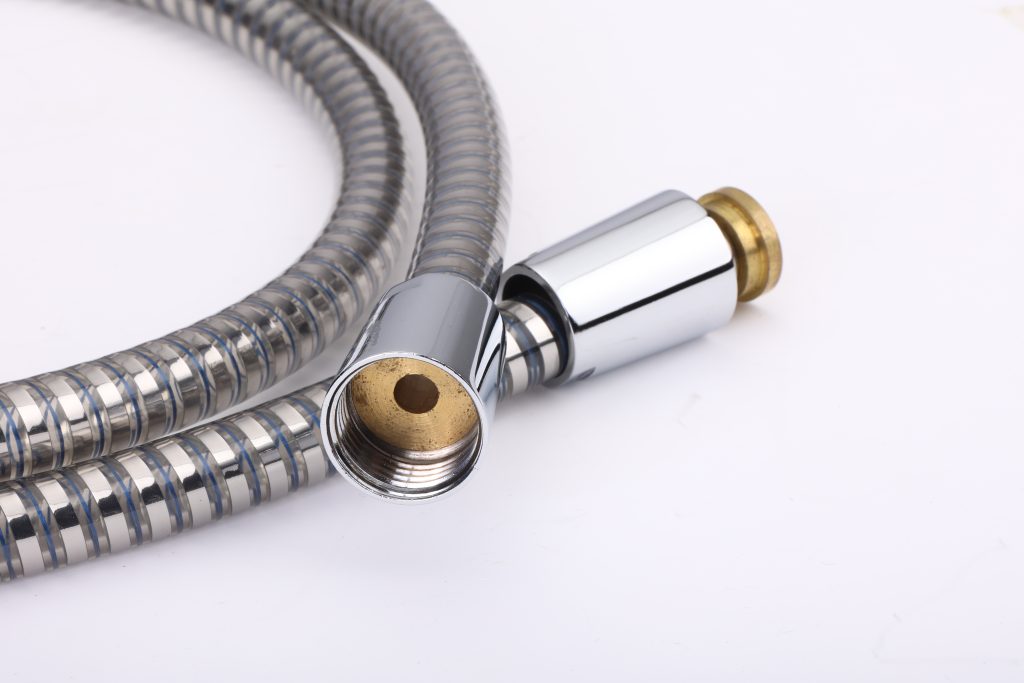
Over the years I have seen the same failure pattern in dozens of bathrooms: a new hose is ordered by guesswork, the thread feels close but does not seat cleanly, and the joint weeps or locks up under pressure. Before buying anything, confirm the exact thread form at both ends of the old hose. In most domestic installations the wall elbow and the handset use a 1/2-inch BSP parallel thread, but the matching seal is made at the face with a rubber washer, not by the thread itself.
Understanding Standard 1/2-Inch BSP and Metric Threads
The 1/2-inch fitting used in most bathrooms is a BSPP (British Standard Pipe Parallel) thread defined by ISO 228-1 and, in much of Europe, cross-referenced by DIN EN ISO 228-1. Its designation is G1/2: a major diameter of 20.955 mm and a pitch of 14 threads per inch. A G1/2 parallel thread is not designed to seal on the thread itself. Instead, the flat end face of the connector compresses a rubber washer against the shoulder of the fitting. That is why a BSPP hose should be fitted with a washer and must not be wrapped with PTFE tape at the face joint; tape can prevent the washer from seating and actually cause a leak. By contrast, BSPT (British Standard Pipe Tapered) threads seal by metal-to-metal interference along the tapered thread, which is why tapered joints are the ones that normally require thread sealant.
| Parameter | G1/2 (BSPP) | G3/4 (BSPP) |
|---|---|---|
| Major diameter | 20.955 mm | ≈26.44 mm |
| Thread pitch | 14 TPI | 14 TPI |
| Typical application | Standard domestic shower supply | High-flow shower supply |
People often mix up rare metric threads with standard G1/2 fittings during home repair work. A G3/4 connector is about 5.5 mm wider than a standard G1/2 pipe joint. A reliable custom maker like GONGGONG offers precise OEM adapters for every correct size choice. This trusted wholesale supplier creates sturdy brass connectors for exact sizing needs. These custom parts convert unusual metric plumbing into safe universal connections that stop leaks completely.
How to Choose the Right Shower Head Size and Connector Type
A tight, leak-free seal does not depend on brute force. On a G1/2 face-seal joint, the rubber washer should sit flat inside the nut, and the nut should be started by hand to avoid cross-threading. I tighten brass nuts hand-tight, then add only a quarter to half turn with a wrench. With plastic or chrome-plated nuts, I stop at hand-tight plus a very light nip: over-tightening is the main reason plastic collars crack after a few thermal cycles.
| Connection symptom | Likely cause | Quick check |
|---|---|---|
| Drip from connection nut | Misaligned washer or bad seal | Check if rubber washer sits flat |
| Spraying from swivel ball | Damaged internal O-ring seal | Inspect O-ring inside ball joint |
| Leak only when water runs | Water pressure pushes through gap | Reseat washer and tighten connection nut |
When I remove an old shower hose that has been in place for several years, the nut is often seized by mineral scale or light corrosion. I start with a short penetrating soak, then turn the nut with a strap wrench rather than gripping the braid with pliers. Once the old hose is off, the rubber washer is frequently stuck to the fitting face or has hardened into a shiny, cracked ring; if it does not peel off cleanly, I gently lift it with a plastic pick and clean the seat before fitting a new washer. On swivel-ball connections I apply a thin film of food-grade silicone grease to the O-rings before assembly. This lets the ball rotate freely and protects the rings from pinching, but I avoid petroleum jelly because it can swell some rubber grades.
Selecting the Right Shower Hose Length and Flexibility
Measuring for Bathroom Layouts and Deep Bathtubs
Length selection should follow the layout of the room and the way the shower is actually used. A short stall needs a hose long enough to reach every corner without stretching, while a deep bathtub with a low-mounted filler usually needs a longer line for rinsing hair and cleaning. I also measure from the wall outlet to the furthest point the handset must reach, then add a small service loop instead of buying the tightest possible length.
| Use case | Recommended shower hose length |
|---|---|
| Shower stall / cabin | 63 inches (160 cm) |
| Standing in a bathtub with a low-mounted faucet | 80 inches (203 cm) |
For an accessible shower, the handset often needs to reach a folding seat and a wall rail while remaining usable from a wheelchair. A longer hose in the 200–250 cm range reduces the need to lean or stretch, but it must not be so long that it coils on the floor and becomes a trip or kink hazard. For pet rinsing, the extra length is useful because the spray head is held low, near the floor or a raised wash station; a wall bracket mounted at a comfortable height keeps the hose off the ground between uses.
Evaluating Anti-Twist Features and Kink Resistance
The swivel end is where most long-term fatigue happens. A quality hose uses a 360-degree rotating conical nut, often with two O-rings inside the swivel body: one seals the rotating joint and the other supports the hose ferrule against the nut. This double-O-ring design keeps the joint stable while the hose rotates, so the inner tube is not twisted at the crimp. On the brass body, a double-lock construction — where the ferrule is mechanically locked on both sides of the braid — resists pull-out far better than a single-lock or glued joint.
| Aspect | Evidence |
|---|---|
| Test condition | Bending under full water pressure |
| Bending-cycle requirement | Over 50,000 cycles without leaking |
| Anti-twist mechanism | 360-degree rotation conical nut |
Before buying, I run a simple field test on a suspect hose: with the hose at room temperature, I bend a short section into a radius of roughly three times the hose diameter and look for any white creasing, flattening or cracking at the bend. A quality EPDM or PEX liner with a well-crimped braid should return to shape without kinking. If the braid kinks at that radius or the inner tube collapses, the hose will restrict flow and fail early at the same point. This manual bend-radius check is not a laboratory cycle test, but it catches the most common real-world weakness in seconds.
Best Shower Hose Materials and Finishes
Selecting Durable Inner Liners and Braiding
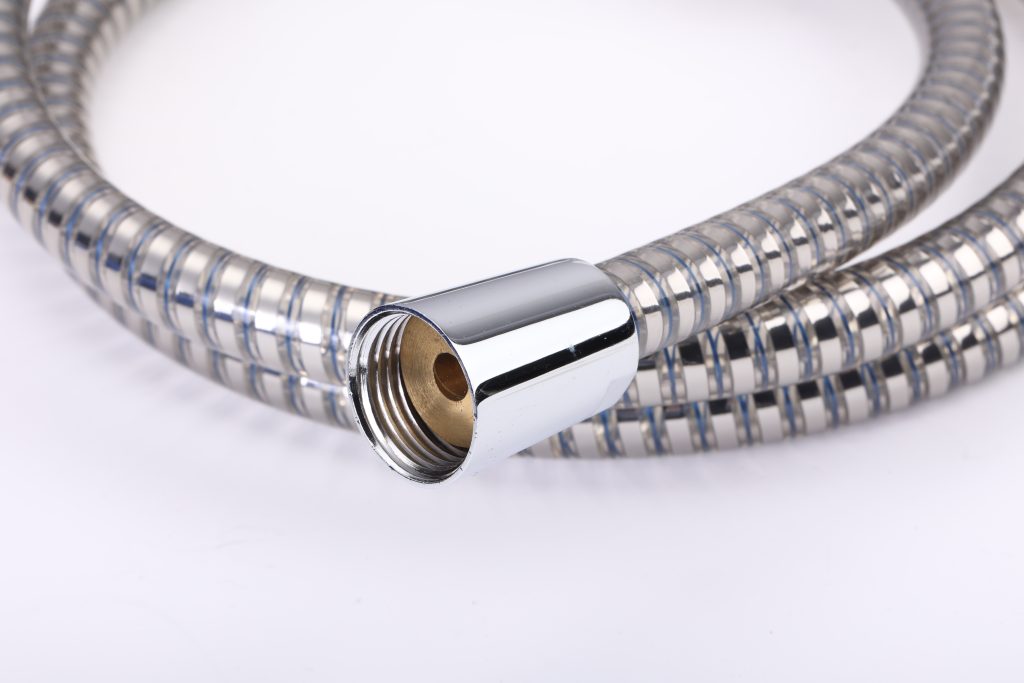
The inner liner is the part that carries drinking water and determines taste, temperature resistance and long-term flexibility. EPDM is the workhorse liner: it tolerates high temperature, resists ageing and has little rubber taste. PEX is stiffer but highly resistant to chlorine and scaling, which makes it a good choice in hard-water areas. PVC liners are cheaper and softer, but they are more likely to smell or plasticise at high temperature, so I only accept PVC when the hose is explicitly rated for the local hot-water temperature. The outer braid — usually stainless steel, an alloy or a PVC sleeve — protects the liner and contributes to the burst-pressure rating, but it is the liner and the crimp that actually hold pressure.
| Reported shower hose outer finish | ASTM B117 salt-spray result |
|---|---|
| Polished, brushed, or color-PVC-sleeve | At least 200 hours, rating 9+ |
When I specify a hose for potable water, I look for independent approval marks rather than marketing claims. WRAS is the main UK scheme for materials in contact with drinking water; ACS covers France; NSF/ANSI 61 covers North America; and WaterMark is the certification used in Australia and New Zealand. Each confirms that the wetted parts have been tested for leaching and are safe for drinking water. A hose can carry one or more of these marks depending on its target market, and the mark should appear on the product or its datasheet, not only on the seller’s website.
Aligning Finishes with Existing Fixtures
Finish matching is a design decision, but the durability of the coating is a technical one. Traditional chrome electroplating is a multi-layer nickel–chromium system that protects the brass or stainless base as long as the coating stays intact. PVD (physical vapour deposition) finishes are harder and more resistant to abrasion and salt-spray corrosion, which is why they are now common on matte black and brushed gold fittings.
| Shower hose outer finish tested | Salt-spray test outcome |
|---|---|
| Polish, Black, Gold | Passed ASTM B117 / ISO 9227 testing |
Strong surface coatings shield the base metal from corrosion in damp rooms, but the base grade still matters once the coating is scratched. In salt-spray testing to ASTM B117 or ISO 9227, a 304 stainless base typically survives far longer before red rust appears than a 201 grade. Buyers should pick the correct attachment size first, then compare the base material and the coating system on the datasheet rather than relying on appearance alone. For a quick field screen, 304 stainless is only weakly magnetic; if a magnet sticks strongly to a part sold as stainless, the base is more likely to be 201 or a ferritic grade with lower corrosion resistance. A drop of stainless-testing solution can confirm the grade, but for most homeowners the magnet check is the fastest first screen.
Before buying a replacement, I check a short list: confirm the thread form and size at both ends, choose a length that suits the actual use without creating floor coils, verify the inner-liner material and drinking-water approvals, and check the working-pressure, burst-pressure and temperature ratings against the household supply. Quality hoses prevent leaks, handle pressure fluctuations, resist kinking and keep daily showering comfortable over many years.
FAQ
What should I do if the new hose thread does not match my wall outlet?
Do not force the nut. Measure the outside diameter and pitch of the male thread with a caliper and thread gauge, then compare it against G1/2 (20.955 mm, 14 TPI). If the fitting is close to 20 mm with a 1.5 mm pitch, it is likely M20x1.5 and needs a dedicated M20x1.5 to G1/2 adapter. For tapered threads, confirm whether the fitting is BSPT before choosing a matching component.
Why does my new shower hose smell or give the water a plastic taste?
The usual cause is a low-grade PVC liner leaching plasticisers into warm water. Switch to a hose with an EPDM or PEX liner, and look for a drinking-water approval such as WRAS, ACS, NSF/ANSI 61 or WaterMark. Flushing the hose with clean water for a few minutes after installation can reduce the initial taste, but it will not fix a liner that is not rated for hot potable water.
Why does water pressure drop after I fit a new shower hose?
Check the hose for kinks, a collapsed inner liner or a flow restrictor in the handset or connector. A smaller internal bore increases flow resistance, so compare the bore diameter with the old hose. Also check that the rubber washer is seated flat and is not partly blocking the inlet; a dislodged washer is a common cause of a sudden, noisy pressure drop.