


One of the most frustrating things for homeowners is discovering their shower hose has burst when they want to take a shower. Many people ask why this happens repeatedly. They see leaks or water spraying out in strange ways. The table below lists common plumbing malfunctions that can cause shower hose problems:
| Reason | Description |
|---|---|
| Shower Valve Cartridge Failure | The cartridge in the shower valve can wear out. This can make leaks happen even if the shower is off. |
| Restricted Tub Spout | A clog in the tub spout can push water back to the shower head. This can cause leaks. |
| Shower Head Connection Issues | Leaks can start where the shower head connects to the hose or wall outlet. |
These problems may look hard, but easy fixes can help most shower hose problems.
Key Takeaways
- Excessive water pressure is the leading cause of shower hose bursts. Keep water pressure below 80 psi, per UPC Section 604.8 and IPC Section 604.8 recommendations for residential plumbing systems. Install a pressure reducing valve (PRV) if readings exceed this threshold.
- Choose hoses that meet ASSE 1071 certification standards, constructed with an EPDM inner core and 304 stainless steel braided jacket. These materials offer superior heat tolerance, burst resistance, and corrosion protection compared to standard PVC hoses.
- Regular inspection, washer replacement, and proper installation technique — including the “hand-tight plus a quarter turn” rule — prevent the majority of leaks and premature failures.
Why Shower Hoses Burst
High Water Pressure
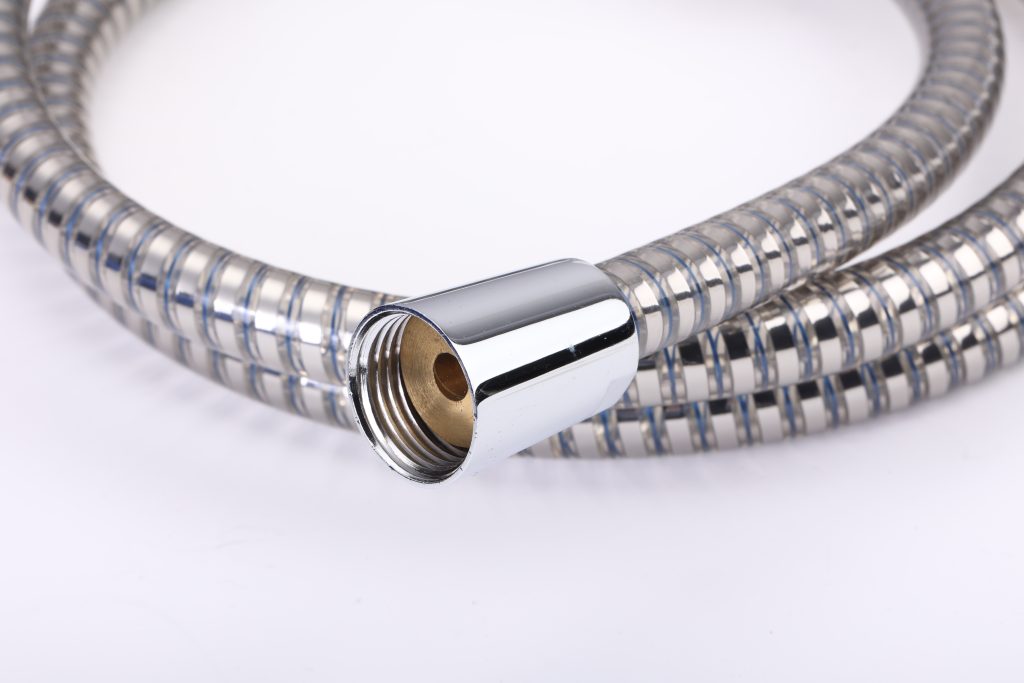
Many people find their shower hoses burst after turning on the tap. Excessive water pressure is the main cause of this problem. If the water pressure is too high, the hose can’t handle it and will start to leak. Most shower hoses work best at 80 psi or lower.
But static pressure readings only tell half the story. The real culprit in many burst failures is water hammer — a transient pressure surge that occurs when water in motion is forced to stop or change direction suddenly. Think about the last time you snapped a lever-handle shower valve shut. The “thud” you hear? That is the sound of a shockwave traveling backward through your pipes.
Here is what happens at the physics level: when a valve closes instantly, the water column adjacent to the valve stops first. The water behind it — still carrying momentum (p = mv) — slams into the stationary column. Since water has very low compressibility, that kinetic energy converts almost entirely into pressure energy, creating a shockwave that propagates backward at roughly 1,300 m/s (the speed of sound in water within typical residential piping). This shockwave then reflects back and forth through the pipe system, and your shower hose bears the brunt of every cycle.
The magnitude of this pressure spike is described by the Joukowsky Equation:
ΔP = ρ · a · Δv
Where ρ is water density (1,000 kg/m³), a is wave speed (roughly 1,300 m/s in copper or stainless steel piping), and Δv is the change in velocity. In a typical residential shower with water flowing at 2 m/s, a sudden valve closure can theoretically generate a pressure spike exceeding 377 psi — nearly five times the recommended operating limit. Even when the static pressure gauge reads a comfortable 60 psi, the hose may endure repeated micro-surges well into the danger zone.
From the field: I once diagnosed a third-floor apartment where the tenant replaced their shower hose every four months like clockwork. Static pressure at the meter was 68 psi — perfectly acceptable. But the building had a direct-feed booster pump with no expansion tank. Every time a neighbor on the same riser shut off a faucet, the pressure spike traveled up to the shower hose. Once we retrofitted a water hammer arrestor at the tee, the problem disappeared. The hose I installed that day was still there two years later when I returned for an unrelated repair. — A retired licensed master plumber
High water pressure can also damage gaskets and seals, making leaks progressively harder to control. This is why both the Uniform Plumbing Code (UPC) and International Plumbing Code (IPC) Section 604.8 require pressure reducing valves in residential systems where mains pressure exceeds 80 psi. If you hear a popping sound in the pipes or notice the hose feels unusually stiff, check the pressure immediately.
Poor Hose Quality or Old Age
The type and lifespan of your shower hose are crucial. High-quality hoses, such as stainless steel braided hoNot all shower hose materials are created equal. The inner core and outer jacket work together as a composite system, and the failure of either layer compromises the entire assembly. The table below compares the four most common hose materials at the molecular and performance level:
| Property | EPDM Rubber (Inner Core) | 304 Stainless Steel (Braided Jacket) | PVC (Standard Hose) | PEX (Cross-linked PE) |
|---|---|---|---|---|
| Key Standard | ASTM D2000 (Class CA/DA) | ASTM A240 / A269 | ASTM D1785 | ASTM F876 / F877 |
| Molecular Structure | Ethylene-propylene-diene terpolymer; saturated backbone, no double bonds in main chain — inherently ozone/UV/heat resistant | Fe + 18% Cr + 8% Ni austenitic alloy; Cr forms passive Cr&sub2;O&sub3; layer for corrosion resistance | Amorphous thermoplastic with plasticizers (phthalates); degrades via dehydrochlorination when heated | Cross-linked polyethylene via peroxide (PEX-A) or silane (PEX-B); 3D network provides thermal memory |
| Continuous Temp. Rating | Up to 150°C (302°F); retains elasticity through thermal cycling | Up to 426°C (800°F); tensile strength derating required above that | Typically 60°C (140°F); plasticizers leach out above this, causing embrittlement | 73°F: 160 psi; 180°F: ~100 psi; loses significant strength above 82°C |
| Burst Resistance | Moderate (when reinforced); standalone burst ~200-300 psi | Excellent; single braid ~4x working pressure (600-6,000+ psi dependent on diameter) | Low; weakens rapidly under thermal + pressure cycling | Good at cold/ambient temperature; drops steeply with heat |
| Chemical Resistance | Excellent vs. water, steam, mild acids/alkalis; poor vs. petroleum oils | Excellent vs. oxidation; susceptible to chloride stress corrosion cracking at >60°C with >50 ppm Cl− | Poor vs. chlorine; sustained Cl exposure causes chain scission and cracking | Excellent vs. scale, chlorine, and most household chemicals; degrades under UV exposure |
| Expected Service Life | 8-12 years (as inner core in braided assembly) | 10-15+ years (braided jacket, not submerged in high-chloride water) | 2-4 years typical; brittle failure mode | 25-50 years (in-wall distribution); shorter as exposed flexible hose |
The industry consensus, reflected in ASSE 1071 certification requirements, favors a composite construction: an EPDM rubber inner core — selected for its fully saturated molecular backbone that resists oxidation, ozone, and thermal degradation — wrapped in a 304 stainless steel braided jacket that provides the burst-pressure rating and abrasion resistance. The 18% chromium content in 304 stainless forms a self-healing chromium oxide (Cr&sub2;O&sub3;) passive layer, which is why properly manufactured braided hoses do not rust under normal domestic water conditions.
PVC hoses, by contrast, rely on plasticizers for flexibility. Under sustained hot water exposure (above 60°C), these plasticizers migrate out of the polymer matrix through a process known as plasticizer leaching. The hose progressively becomes stiff, then brittle, and eventually cracks — often at the crimp ends where mechanical stress is highest. I have pulled PVC hoses out of bathrooms where they literally snapped in half when bent, like a dried twig.
Here is what you should look for when selecting a replacement hose:
Stainless steel braided hoses typically last three to five years longer than ordinary PVC or rubber hoses. Households that shower frequently may need to replace their hoses every two to three years. Individuals living alone can wait four to five years before replacing theirs.
ASSE 1071 certification marking on the packaging — this confirms the hose has passed hydrostatic pressure testing (typically 300 psi static for 2 minutes) and cyclic surge testing, and includes integral backflow protection.
IAPMO or ICC-ES listing mark — necessary for UPC/IPC code compliance in most North American jurisdictions.
Installation Problems: What Goes Wrong and How to Avoid It
Bad installation can make a shower hose leak or burst. People sometimes twist, bend, or stretch the hose too much when putting it in. The table below lists common mistakes:
| Common Mistakes | Description |
|---|---|
| Excessive twisting | Can hurt the flexible hose during installation. |
| Sharp bending | Makes the hose weak and can cause bursts. |
| Overstretching | Lowers the hose’s ability to handle pressure. |
Loose connections, tightening too much, or using bad connectors also cause leaks. If people do not tighten the hose or use new washers, water can leak out. Bad installation and cheap connectors make leaks more likely. People should check the hose and shower arm for leaks. If the hose looks rusty or corroded, it may need to be replaced.
Pro tip — the “hand-tight plus a quarter” rule: Shower hose connections use rubber washers to create the seal, not metal-to-metal thread engagement. Tighten the swivel nut by hand until it seats firmly against the washer, then add no more than one quarter-turn with a wrench if absolutely necessary. Over-tightening crushes the rubber washer flat, causing it to lose its elastic memory — and that is when leaks start. Never use pipe dope or thread sealant on swivel nuts; they interfere with the washer’s ability to seat evenly. If you use PTFE tape, apply 3-4 clockwise wraps on the thread as an anti-galling lubricant and dielectric barrier, never as a sealant substitute.
From the field — the anti-kink loop: When installing a new hose, always leave a natural loop or sag between the wall elbow and the handset holder. A hose pulled taut is a hose under constant tension at the crimp ends. After a few hundred hot-cold cycles, that tension turns into a bulge, then a pinhole, then a full burst. I tell every apprentice: “If the hose looks like a tight guitar string, you have already lost.” — A retired licensed master plumberck the hose and shower arm for leaks. If the hose looks rusty or corroded, it may need to be replaced.
Wear, Tear, and Environmental Factors
All shower hoses wear down over time. Hard water, temperature changes, and frequent use accelerate this All shower hoses wear down over time. Hard water, temperature changes, and frequent use accelerate this process.
Hard water contains dissolved minerals — predominantly calcium ions (Ca²+) and magnesium ions (Mg²+) — held in solution as soluble bicarbonates: Ca(HCO&sb3;)&sb2; and Mg(HCO&sb3;)&sb2;. This equilibrium is fragile. When water is heated (as it passes through a shower hose carrying hot water) or when pressure drops at the shower head, dissolved CO&sb2; is released as gas. The loss of CO&sb2; shifts the chemical equilibrium, converting the soluble bicarbonates into insoluble calcium carbonate (CaCO&sb3;) and magnesium hydroxide (Mg(OH)&sb2;) — the white, chalky scale you see on shower fittings:
Ca(HCO&sb3;)&sb2;(aq) → CaCO&sb3;(s) + CO&sb2;(g) + H&sb2;O(l)
Mg(HCO&sb3;)&sb2;(aq) → Mg(OH)&sb2;(s) + 2CO&sb2;(g)
This scale does not just clog shower heads. Inside a flexible hose, mineral deposits narrow the effective internal diameter, which increases flow velocity and back-pressure for any given flow rate. The rough scale surface also provides nucleation sites that trap more minerals, sediment, and biofilm — accelerating the blockage. The Water Quality Association (WQA) notes that even moderate hard water (7-11 grains per gallon or 120-180 mg/L as CaCO&sb3;) can reduce the effective service life of plumbing components by 30-50% without treatment.
Chlorine in municipal water supplies presents an additional threat, particularly to PVC hoses. Sustained chlorine exposure causes chain scission — the breaking of polymer backbone bonds — which manifests as surface cracking, discoloration, and eventual brittle fracture. EPDM rubber’s saturated molecular backbone is inherently resistant to this degradation pathway, which is another reason ASSE 1071-compliant hoses specify EPDM or equivalent elastomers for the inner core.
Signs that a shower hose may burst include:
- Rusty or corroded braided hose
- Excessive twisting, knotting, or stretching of the hose
- Damage caused by high water pressure
- Improper installation or use of inferior fittings
High-traffic bathrooms and homes with hard water require strong, durable hoses. Stainless steel braided hoses won’t rust, remain flexible, and withstand temperature changes well. PVC hoses are lightweight and inexpensive, but require more frequent replacement. If you notice damage to the hose or persistent leaks, repair and replace the hose as soon as possible. Using new gaskets and checking the seals helps prevent leaks.
If your shower hose is leaking, follow these steps: Inspect the connections, replace the gaskets, and tighten the hose. If the leak persists, there may be a more serious plumbing problem. Regularly inspecting and maintaining your hose helps extend its lifespan and prevents it from bursting.
From the field — the electrolysis surprise: I once visited a home where the owner had replaced their shower hose every 8-10 months for three years. The threads on every failed hose showed the same pattern: a blue-green crust and pitted metal at the ferrule. Took me a while, but I traced it to a faulty ground connection in the electrical panel. Stray current was using the plumbing as a ground path, and the hose connectors became sacrificial anodes. This is called dielectric corrosion or electrolytic degradation. If your hoses fail with the same odd corrosion pattern repeatedly, have an electrician check your home’s grounding — it is more common than you would think. — A retired licensed master plumber
Preventing Shower Hose Bursts
Control Water Pressure
Excessive water pressure can cause shower hoses to burst. People often don’t realize how much pressure can build up in their home’s plumbing. A simple pressure gauge can help you check your home’s water pressure. If the reading exceeds 80 psi, action should be taken.
Both the Uniform Plumbing Code (UPC) and International Plumbing Code (IPC) Section 604.8 require that residential water pressure not exceed 80 psi at the point of use. When supply pressure exceeds this threshold, the codes mandate installation of a pressure reducing valve (PRV). A qualified plumber can install and calibrate a PRV to maintain system pressure within the safe 50-60 psi range recommended by the American Society of Plumbing Engineers (ASPE) in their Plumbing Engineering Design Handbook — protecting not just your shower hose but also water heaters, washing machine hoses, and all downstream fixtures.
For transient pressure spikes caused by water hammer, a water hammer arrestor is the correct engineering solution. These devices — typically piston-type or bellows-type chambers installed at the fixture branch — provide a compressible air cushion that absorbs the shockwave before it can reflect through the piping. They are required by ASSE 1010 and referenced in both the UPC and IPC for quick-closing valve applications.
Tip: If the shower sprays water too hard or the hose feels stiff, check the pressure. Lowering it can prevent leaks and save money on repairs. A pressure gauge that threads onto a hose bib costs under $20 at any hardware store and takes 30 seconds to read.
Choose a Quality Shower Hose
Not all shower hoses are created equal. Some hoses are made of thin plastic or fragile metal and are easily damaged. When selecting a replacement, look beyond the marketing claims and focus on the certifications and material specifications that matter.
The industry benchmark for shower hose performance is ASSE 1071: Performance Requirements for Flexible Shower Hose. A hose that carries the ASSE 1071 mark has been independently verified to meet the following minimums:
| ASSE 1071 Requirement | Test Criteria |
|---|---|
| Hydrostatic Pressure Test | Must withstand 300 psi static water pressure for 2 minutes without bursting or leaking |
| Cyclic Surge Test | Must survive repeated pressure surge cycling without fatigue failure |
| Kink & Torsion Resistance | Must resist kinking under specified bending radius and twisting loads |
| Backflow Protection | Must include an integral check valve to prevent contaminated water from siphoning back into potable supply (required by IPC Section 608.15.5 and UPC Section 313.0) |
| Material Safety | Wetted components must comply with NSF/ANSI 61 (drinking water system components) and NSF 372 (lead content ≤ 0.25% weighted average) |
In addition to ASSE 1071, look for the IAPMO R&T listing mark (a shield logo) or ICC-ES certification on the packaging. These marks indicate that the product has been evaluated against the relevant model plumbing code and is acceptable for use in UPC and IPC jurisdictions respectively.
The following composite construction represents the current best practice in the industry:
- Inner core: EPDM rubber (ASTM D2000 Class CA/DA), selected for its saturated molecular backbone that resists thermal degradation, ozone cracking, and chlorine attack. Maintains elasticity from -50°C to +150°C.
- Outer jacket: 304 stainless steel braided sleeve (ASTM A240), providing the primary burst-pressure rating and mechanical abrasion protection. The Cr&sub2;O&sub3; passive layer is self-healing in the presence of oxygen.
- End fittings: Brass or stainless steel swivel nuts with integral EPDM sealing washers. Threaded to 1/2″ NPSM (National Pipe Straight Mechanical) or G 1/2″ standard — note the straight (non-tapered) thread design is intentional, as the washer creates the seal, not the thread engagement.
- End connections: Must be rated for minimum 125 psi working pressure at 82°C (180°F) continuous.
A high-quality shower hose should come with sturdy gaskets and sealing rings. These components help maintain a watertight seal at each connection. When choosing a new shower hose, opt for well-regarded and certified products. A robust and durable hose means fewer leaks, fewer maintenance needs, and a longer lifespan.
Install and Maintain Properly
Proper installation and regular maintenance ensure your shower hose stays in good working order. Always use new gaskets when installing the hose. This helps create a tight seal and prevents leaks. Also, check the gaskets and connections for signs of wear or damage. If the hose feels loose, manually tighten the connections. Over-tightening can damage the gaskets or seals, so gentle pressure is best.
Regular cleaning keeps your shower hose in optimal condition. Soap scum, minerals, and bacteria can build up inside and outside the hose. Cleaning with mild soapy water prevents this buildup. Avoid using harsh chemicals that could damage the hose and gaskets. Every few months, check the hose for cracks, leaks, or blockages. If a leak is found, it can be repaired by replacing the gasket or seal.
Here are some simple shower hose maintenance steps:
- Clean the hose exterior with mild soapy water — avoid abrasive cleaners on stainless steel, which can scratch the chromium oxide passive layer and initiate rust spots.
- Check the hose, gaskets, and seals for cracks or leaks at least every three months.
- Test the hose’s flexibility — a hose that feels stiff or resists bending is approaching end of life.
- If the connection is leaking, replace the washer — do not just tighten harder.
- Repair any leaking shower hoses immediately; a slow weep of hard water will deposit calcium carbonate at the leak point and make future repairs far more difficult.
- Before using a newly installed hose, unwind any factory twist by letting the hose hang freely and rotating the swivel nut until it settles naturally.
A well-maintained hand shower hose can last for years. Regular inspections and timely maintenance ensure safe and comfortable showering. If the hose shows signs of damage or leakage, replacement is the best option. A new shower hose with a strong washer and sealing ring will restore water tightness and completely solve the leak problem.
Shower hoses can burst for a few reasons. High water pressure — both static and transient (water hammer) — is the primary cause. Inferior materials or loose connections can also make them burst. Hard water mineral deposition silently narrows the internal passage, increasing back-pressure until failure. Checking the hose often helps stop leaks. Fixing problems quickly keeps the shower working well. Selecting a quality shower hose that meets ASSE 1071 standards has many benefits:
- Rust resistance helps the shower stay clean and strong over years of use.
- Extended service life means fewer replacements and lower long-term costs.
- Properly flexible hoses, installed with a natural loop, make showers more comfortable and reduce stress on connections.
Following these guidelines helps you worry less. You will also enjoy your shower more each day.
FAQ
Why does my new shower hose leak right after installation?
A loose connection or missing washer is the most common cause. Always use a new rubber washer (never reuse the old one), hand-tighten the swivel nut, and add no more than a quarter-turn with a wrench only if needed. If it still leaks, remove the nut and check whether the washer is seated flat — a tilted or pinched washer will never seal.
How often should someone replace a shower hose?
Most people replace their shower hose every 2-5 years. Heavy use or hard water may require more frequent changes. The replacement interval depends heavily on material quality: a stainless steel braided hose with EPDM inner core (ASSE 1071 certified) typically lasts 5+ years in normal residential use, while standard PVC hoses may need replacement in 2-3 years.
What certifications should I look for when buying a replacement hose?
| Certification | What It Verifies |
|---|---|
| ASSE 1071 | Performance-tested for burst pressure, cyclic surge, kink resistance, and backflow protection |
| IAPMO R&T / ICC-ES | Evaluated against UPC / IPC model plumbing codes for code-compliant installation |
| NSF/ANSI 61 | Materials safe for contact with drinking water; no harmful contaminants leach into water |
| NSF 372 | Lead content ≤ 0.25% weighted average (compliant with U.S. Safe Drinking Water Act) |
A certified hose built to recognized standards provides documented performance assurance and is far less likely to fail prematurely.
Can a water hammer arrestor really prevent my hose from bursting?
Yes — and in homes with quick-closing valves (modern ball-valve shower mixers, solenoid-controlled appliances), a water hammer arrestor is often the single most cost-effective upgrade. The pressure spike from a sudden valve closure — governed by the Joukowsky equation — can exceed 350 psi even when static pressure reads a benign 60 psi. A properly sized piston-type arrestor installed at the fixture branch absorbs this transient shockwave, protecting not just the shower hose but every flexible connector and gasket downstream. These devices are required by ASSE 1010 for quick-closing valve applications and are referenced in both the UPC and IPC.